
Weight Distribution Hitch Guide for Maryland Drivers
Transportation workers know that the hitch is a critical part of the job. Towing a heavy trailer on Maryland roads requires more than just a standard ball hitch. For heavy loads, the right towing setup is a safety issue, not just a performance one. This is often why a weight distribution hitch is recommended.
A weight distribution hitch is a specialized trailer hitch designed to evenly distribute a trailer’s tongue weight between the tow vehicle and the trailer. Rather than letting all the weight concentrate at the rear axle of your tow vehicle, a weight distribution hitch disperses it across all axles (front and rear) to keep your rig level and stable on the road.
For heavier loads, this isn’t optional equipment; it’s critical for safety. A properly set weight distribution hitch enhances towing stability, protects the trailer from dangerous swaying, and prevents the front of your tow vehicle from lifting off the ground — a condition known as “diving” — which can severely compromise steering and braking.
At C&C Trailer in Gaithersburg, MD, our transportation professionals help with weight distribution hitches and offer expert hitch services.
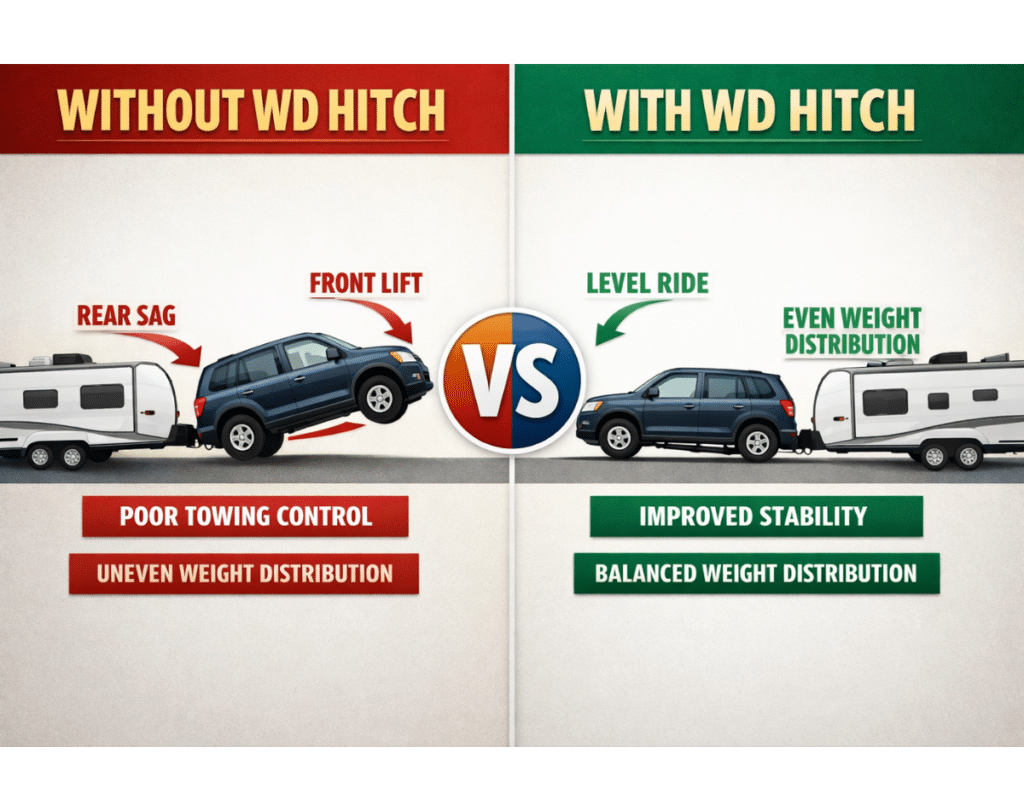
How Weight Distribution Hitches Work
A weight distribution hitch assists with tongue weight on your towing load. Tongue weight is the downward force the trailer tongue exerts on the hitch ball. It should fall between 10–15% of your Gross Trailer Weight (GTW). A tongue weight below 10% GTW causes trailer sway; above 15% forces the rear axle to dive, lifting weight off the front wheels and compromising control.
With a standard hitch, all tongue weight transfers to the rear axle; this includes the rear squats and the front lifts, which causes steering and braking to suffer. A weight distribution hitch disperses that load across all axles of both the tow vehicle and trailer.
The weight distribution hitch works by attaching spring bars to the hitch head and trailer A-frame. Under tension, the springs lever down on the trailer frame and lift the rear of the tow vehicle, keeping the rig level and parallel with the road. This maintains safety for long hauls, short trips, and any other transportation of heavy loads across Maryland and neighboring states.
Safety Benefits of Weight Distribution Hitches
- Reduced trailer sway — A level, balanced setup tracks straighter and responds more predictably in lane changes, merges, and crosswinds.
- Enhanced steering response — Spring bars transfer load forward, helping front tires grip the road the way the vehicle was engineered to.
- Increased braking effectiveness — Balanced axles help anti-lock braking systems (ABS) and brake bias work as intended, especially during emergency stops.
- Minimized stress on vehicle components — Proper weight distribution reduces long-term wear on your suspension, rear axle, and drivetrain.
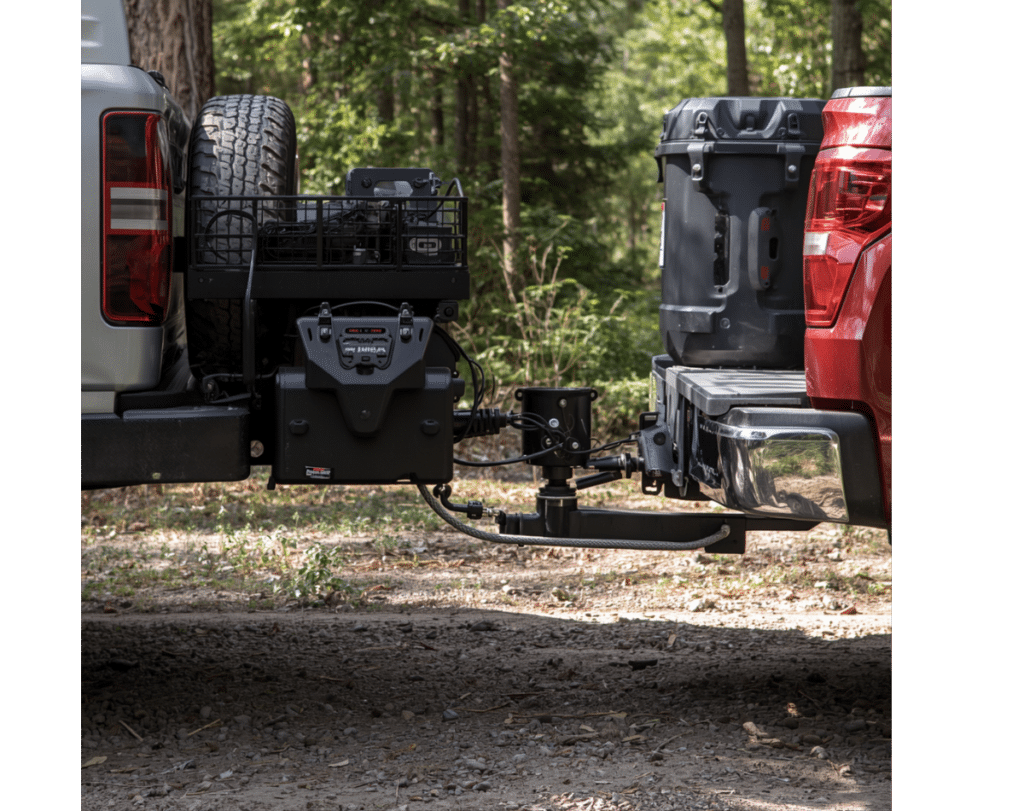
Types of Weight Distribution Hitches
Round Bar vs. Trunnion Bar
The two most common weight distribution hitch designs are defined by their shape and attachment point of the spring bars.
Round bar weight distribution hitches use curved, round steel spring bars that protrude from the bottom of the hitches and are a smart option for vehicles with lighter suspension, such as SUVs and light trucks. They tend to be more affordable and are widely available, making them the most common type on the market.
A trunnion bar weight distribution hitch has square steel arms that attach at the front face of the hitch head. This gives better ground clearance and higher weight capacity and is suited for heavier truck-and-trailer combinations.
In terms of towing performance, there is no significant difference between round bars vs trunnion bars when properly matched to your load. The choice of a weight distribution hitch largely comes down to your weight requirements, clearance needs, and personal preference.
Without Sway Control vs. With Sway Control
Weight distribution hitches without sway control focus on leveling the tow vehicle and trailer by redistributing tongue weight across axles. These do not actively resist side-to-side trailer movement. While a weight distribution hitch will inherently reduce some sway by restoring balance, a dedicated sway control component provides an additional layer of lateral stability.
Weight distribution hitches with sway control incorporate friction-based mechanisms (either integrated into the hitch system or as a separate add-on unit) that actively resist the trailer’s tendency to swing side to side. Integrated sway control systems combine weight distribution and sway management into a single, streamlined setup.
For longer trailers or travel in regions with strong winds and uneven terrain, a sway control system adds valuable lateral stability. This can be critical for Maryland drivers who must traverse the Bay Bridge or contend with unpredictable weather, heavy storms, and high winds.
Hitch-Mounted vs. Trailer-Mounted
Hitch-Mounted Hitches attach primarily to the tow vehicle’s hitch receiver, with all components — shank, head, and spring bars — housed on the vehicle side. This is the traditional and most common configuration.
Trailer-Mounted Hitches keep the majority of the hitch components on the trailer side, which simplifies hookup and unhooking. If you frequently hitch and unhitch your trailer, a trailer-mounted system can offer a more user-friendly experience.

What to Consider Before Choosing a Weight Distribution Hitch
Loaded Trailer Weight
GTW is the total loaded weight of the trailer — including cargo, fuel, and gear. Your weight distribution hitch must be rated to meet or exceed this number. Verify using manufacturer specs, never estimates.
Actual Tongue Weight
The actual tongue weight should be 10–15% of GTW. Measure with a tongue weight scale — knowing the actual figure, not an estimate, is essential for selecting the right hitch rating. C&C Trailers can assist Maryland drivers with determining their GTW and tongue weight for accurate sizing.
Hitch Ratings
Receiver hitches carry two ratings: a dead-weight capacity and a higher, weight-distribution-specific rating. Always use the weight distribution rating and never exceed the lowest-rated component in the chain. If your receiver has no weight-distribution rating listed, a weight-distribution system cannot be used.
Tow Vehicle Suspension
Rear sag when hitched is a sign that tongue weight is overloading the rear axle. A weight distribution hitch restores front-axle load and levels the rig.
Note: weight distribution hitches are for body-on-frame vehicles (trucks and truck-based SUVs) only — car-based unibody vehicles may not be compatible. Always check your owner’s manual.

Other Frequently Asked Questions
How Do Weight Distribution Hitches Impact Braking and Steering?
Without a weight distribution hitch, tongue weight overloads the rear axle, causing floaty steering and longer stopping distances. A weight distribution hitch transfers load forward, restoring front-tire grip, stabilizing ABS and brake bias, and improving predictability in lane changes and crosswinds. This improves both braking and steering for drivers. For Maryland drivers, this can assist with the stop-and-go traffic often found near DC, on the 695 beltway, and around I-95.
When Do You Need a Weight Distribution Hitch?
A weight distribution hitch is generally recommended when your trailer weighs 50% or more of your tow vehicle’s weight, or when towing over 5,000 pounds. Signs you need one include:
- Your vehicle squats noticeably when the trailer is connected
- Your headlights angle upward instead of illuminating the road ahead
- Steering feels light or imprecise while towing
- Stopping distances increase with the trailer attached
- You experience trailer sway at highway speeds
Should I Get a Sway Control Unit With My Weight Distribution Hitch?
Yes. Most weight distribution hitches are compatible with sway control — either integrated or as an add-on. For longer trailers or highway and mountain driving, using both systems together is the safest setup.
Can I Back Up With a Weight Distribution Hitch?
Yes, in a straight line. Tight turns while reversing can stress the spring bars. Some chain-style hitches restrict backing entirely — if you frequently back into tight spaces, look for a backup-compatible or trailer-mounted system.
Are Weight Distribution Hitches Compatible With Surge Brakes?
Most chain-style weight distribution hitches are not compatible with surge brakes. Some manufacturers make surge-brake-compatible systems — confirm compatibility before purchasing.
Contact C&C Trailers for Assistance in Gaithersburg
Have another question we didn’t answer about weight distribution hitches for your Maryland towing setup? CC Trailer in Gaithersburg, MD, is here for you. Contact us today to ask about trailer towing, weight distribution, optional setups, and more. We are also a Maryland State Safety Inspection Station, so we recommend exactly what you need for your personal or business set up. Call today or send us a message.